Compare
Deluge, qBittorrent, Transmission — and Ferrent.
A feature-level view, not a benchmark. The table focuses on what a self-hoster actually touches: labels, scheduling, notifications, migration and the web UI.
| Feature | Deluge | qBittorrent | Transmission | Ferrent |
|---|---|---|---|---|
| Platform | Linux · macOS · Windows | Linux · macOS · Windows | Linux · macOS · Windows | Linux · Windows preview |
| Queue and priority | Yes | Yes | Yes | Yes |
| Bandwidth scheduler | Plugin | Yes | Yes | Yes |
| RSS with regex filter | Plugin | Yes | No | Yes |
| Torrent creation CLI and GUI, with default trackers. | Yes | Yes | Yes | Yes |
| HTTP/SOCKS proxy | Yes | Yes | No | Yes |
| Web UI and remote control | Plugin | Yes | Yes | Yes |
| Labels with actions | Plugin | Yes | No | Yes |
| Sequential download | Yes | Yes | No | Yes |
| Super-seeding | Yes | Yes | No | Yes |
| IP blocklist | Plugin | Yes | No | Yes |
| Web Push / PWA Browser push on finished/error; the SPA installs as a PWA. | Plugin · desktop | No | No | Yes |
| Statistics and graphs | Plugin | Yes | Yes | Yes |
| Search across sites | No | Yes | No | No |
| Streaming while downloading | No | Yes | No | No |
| Auto-update APT and NSIS installers; no in-app updater yet. | No | Partial | Yes | Partial |
| Localisation | many | ~70 | many | English · Hungarian |
Yes / Native · Plugin / Add-on · Partial / Limited · No / Missing
Sources: project docs, upstream feature pages and the 2026-11-25 matrix measurement.
Parity
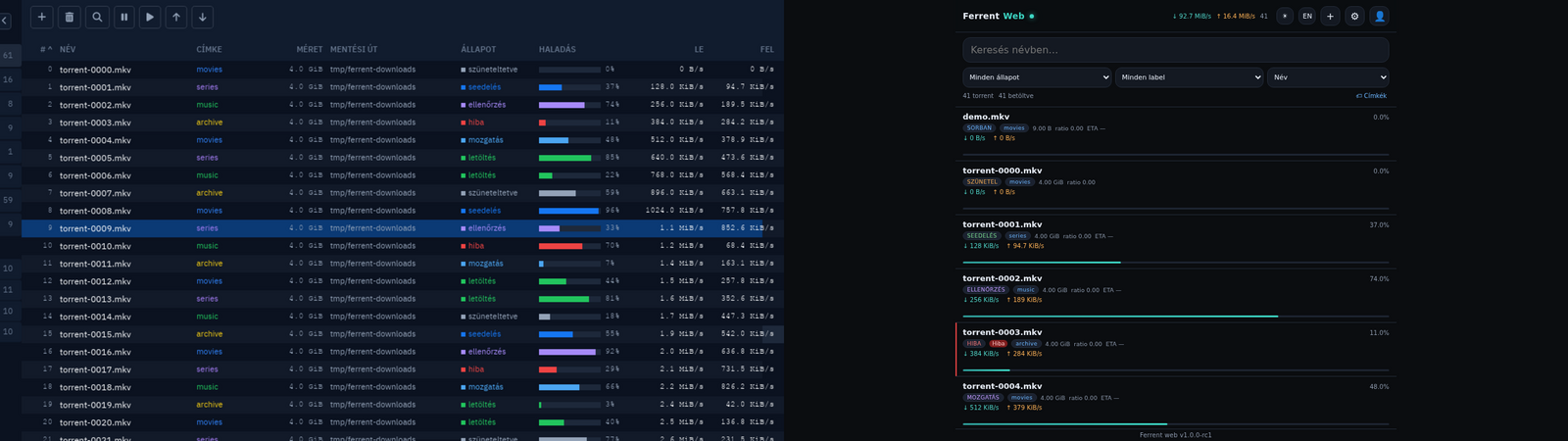
Desktop and web, one daemon
The native GUI and the browser UI talk to the same daemon over TLS. Labels, queue moves, trackers and settings are not a second implementation.
How to read this
“Plugin” means the feature exists upstream as a separate add-on. “Partial” means it is limited or platform-specific. The matrix is maintained in the repository and re-measured against the code, not copied from marketing pages.
The short version
- Labels, queue, scheduler, RSS, blocklists and web seeds are native.
- TLS, token auth and Web Push are built into the daemon/gateway.
- Streaming, extractor, search and in-app update are still open.